Classic Quinta near Lagos
Self catering holiday rental villa with seaview and privacy, Western Algarve, Portugal
 Lagos
is the third largest town in the Algarve,
straddling the river Bensafrim and surrounded by
beautiful, unspoilt countryside. It is a lively, cozy
town with a maze of winding cobbled streets full of
pavement restaurants, local cafés bars,
antique and art shops, and what must be one of the
world's best stocked fish markets. It is also
rich in culture and history, and is widely regarded
as the most charming town of the Algarve.
Lagos
is the third largest town in the Algarve,
straddling the river Bensafrim and surrounded by
beautiful, unspoilt countryside. It is a lively, cozy
town with a maze of winding cobbled streets full of
pavement restaurants, local cafés bars,
antique and art shops, and what must be one of the
world's best stocked fish markets. It is also
rich in culture and history, and is widely regarded
as the most charming town of the Algarve.
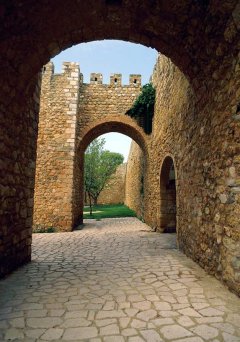 Lagos was an important
coastal settlement well before the beginning of our
era. The impressive town walls, still largely intact,
date back to Roman times. During the Moorish
occupation which lasted until the 12th century, Lagos
was the centre of trade between Portugal and
Africa.
Lagos was an important
coastal settlement well before the beginning of our
era. The impressive town walls, still largely intact,
date back to Roman times. During the Moorish
occupation which lasted until the 12th century, Lagos
was the centre of trade between Portugal and
Africa.In the days of the great discoveries, Lagos was the heart of naval Portugal. Its ship yards built the caravels for the voyages of exploration, and it was here, close to Cape St. Vincent, the South-Westerly tip of continental Europe, that Henry the Navigator´s captains, Gil Eanes and Magelhães took to the sea. Still a fishing town, and since the end of the last century the home of a major marina, Lagos has a rich nautical flavour. The gaily painted fishing boats line berths along the river, yachts sail out to Madeira, the Azores and the far ends of the earth. Sightseeing With a such a long and varied past, Lagos has plenty of historical sights that are well worth taking in during your stay. Sections of the old Roman wall ( most of which was demolished in the great earthquake of 1755) can be seen at the back of the town. The site of the first slave market to be established in Europe is just off the main avenue and the hospital nearby is the former palace of Dom Henrique. The golden Church of Santo António, a superb example of Portuguese 18th C baroque, inlaid with gold leaf and elaborate wood carvings, is well worth a visit. |
|
|
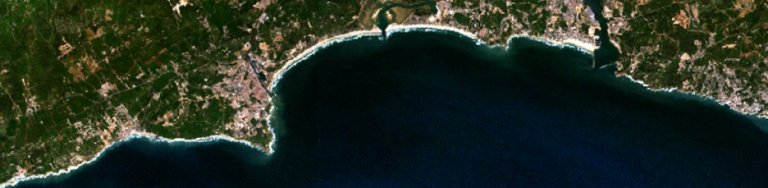
Beaches There is a fine sandy beach in town beneath the imposing wall of an ancient Fortress which still stands guard over the harbour entrance. Perhaps the most impressive beach in the area (and the one closest to the quinta) is Meia Praia, a 5 kilometer stretch of dunes and golden sand - the long sweeping curve in the centre of the picture. It has great views of the old town and the Monchique hills in the distance. Meia Praia begins on the eastern side of the railway station and has watersport facilities, sun-beds and sun shades for hire. Half a dozen unpretentious restaurants serve simple local food from fresh ingredients, wine from the Alentejo and the fabled Algarvian bica pingada with steamed milk, essentially a macchiato with an even cuter name. |
| The
string of small beaches on the western side of Lagos
including the picturesque Praia D´Ana and Porto
de Mós. Smaller and more
intimate coves may be reached by
boat. The famous cliff walk on Ponte da Piedade is
recommended for the sure-footed and mentally stable.
A short boat trip
from Lagos takes you round the rock formations and
grottoes of Ponta da Piedade, between Luz and Lagos.
The boats depart from Praia D`Ana and the Lagos riverside. Boat (day) trips to Sagres give you the possibility to seeing the beautiful coast line from Lagos to Sagres. These trips start from the pontoon in the harbour. |
 Aljezur and the West
Coast The beautiful West Coast
with its dramatic cliffs and rock
formations is still largely virginal and there are
some fantastic beaches - famous for fishing and
bird-watching - but usually unsignposted and hidden
from the road by high sand dunes. Aljezur is an
old town, founded by the Arabs in
the 10th Century. Climb up to the ruins of the
old Castle and enjoy spectacular views over the
surrounding countryside. Aljezur makes a good
central point for a drive through the Western
Algarve. Take EN 125 from Lagos to Vila do Bispo
and then turn North, over the hills of the
Dog´s Spine Ridge and down into Carrapateira,
where you will find the first of the wonderful West
Coast beaches. From there continue to Aljezur and
return to Lagos on the EN120 - or head North towards the
Lower Alentejo. Notice the stork nest on top of the rocks.
Aljezur and the West
Coast The beautiful West Coast
with its dramatic cliffs and rock
formations is still largely virginal and there are
some fantastic beaches - famous for fishing and
bird-watching - but usually unsignposted and hidden
from the road by high sand dunes. Aljezur is an
old town, founded by the Arabs in
the 10th Century. Climb up to the ruins of the
old Castle and enjoy spectacular views over the
surrounding countryside. Aljezur makes a good
central point for a drive through the Western
Algarve. Take EN 125 from Lagos to Vila do Bispo
and then turn North, over the hills of the
Dog´s Spine Ridge and down into Carrapateira,
where you will find the first of the wonderful West
Coast beaches. From there continue to Aljezur and
return to Lagos on the EN120 - or head North towards the
Lower Alentejo. Notice the stork nest on top of the rocks. |
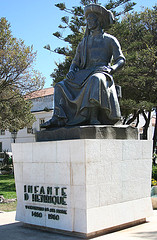 Sagres
Called "Sacrum Promontorium", was
considered sacred in pre-historic times and people
believed that the Gods gathered here. It is a small
fishing village, with a population of approximately
2.500, living of fishing and tourism.
Sagres became well known during the XVth
century, when Dom Henrique,
'Prince Henry the Navigator', chose it as the home of
his Navigation School. It was from Sagres that
Prince Henry prepared the great Portuguese discoveries,
all of them journeys into totally unknown territory. Lagos,
the last port before the land's end of Cape St. Vincent, was the staging point
for much of the world's discovery. From here sailors first ventured
around the cape, laying open the routes to Africa and Asia.
Even today few sailors from Europe make their way to Brazil
without a last stopover in Lagos.
Sagres
Called "Sacrum Promontorium", was
considered sacred in pre-historic times and people
believed that the Gods gathered here. It is a small
fishing village, with a population of approximately
2.500, living of fishing and tourism.
Sagres became well known during the XVth
century, when Dom Henrique,
'Prince Henry the Navigator', chose it as the home of
his Navigation School. It was from Sagres that
Prince Henry prepared the great Portuguese discoveries,
all of them journeys into totally unknown territory. Lagos,
the last port before the land's end of Cape St. Vincent, was the staging point
for much of the world's discovery. From here sailors first ventured
around the cape, laying open the routes to Africa and Asia.
Even today few sailors from Europe make their way to Brazil
without a last stopover in Lagos.Cape St. Vincent Separated from the point of Sagres by Praia do Beliche one can see Cape St. Vincent. The cape was so named after the body of St. Vincent came to that spot in the IVth Century, and there was guarded by ravens for centuries, until it was taken to Lisbon in 1173. Here were fought important naval battles, and also existed St. Jeronimus "Convent, house for St. Vincent Pilgrims". |
| Monuments Walls and
fortress date back to the XVth century. The fortress
was rebuilt in the 18th century after Vauban´s
system. The reconstruction was finished in the year
1793 as to be seen in the escutcheon on the wall,
facing the square. Inside, designed on the ground,
one finds a geometrical figure made of rough stones
and 43 meters diameter. Known as the windrose,
(mariner´s compass) which is believed to date
back to Prince Henry´s times. The windrose was
only discovered in 1918. |
| Henry the Navigator
Prince Henry "The Navigator"
was born in 1394 and was born in 1394 and was 3rd son
of King John the 1st of Portugal and Philipa of
Lancaster, who was English by birth. (Philipa of
Lancaster was the daughter of John of Gaunt, 3rd Son
of King Edwards the III rd of England). Very little
is known of his youth, except his interest in Africa
and his strong will becoming, a knight in battle,
which happened soon after his conquor of Cueta, in
"Marrocos", in the 21st, 1415. In 1419,
King John the 1st, his father, appointed him as
Governor of the Algarve, as well as a aster of
Christ´s order. Prince Henry settled in Lagos a
few km away from Sagres. He became so well known
that, men came from all over asking to sail under his
flag. In 1485 he decided to undertake a new crusade
to Marroco with the help of his nephew Afonso the
5th. The attack of Alcacer was a personal success for
Prince Henry, but too much of an effort for his 66
years of age and in November 13th 1460, he died in
Sagres. Prince Henry´s tomb can be seen in the
Monastery of Batallha (Monastery of St. Mary of
Victory), some distance North of Lisbon. |
| Portimão Portimão is a good shopping centre
and a fascinating fishing harbour. Go in the morning
- as early as possible - stroll along the quayside
and watch the colourful fishing boats coming in and
off - loading their catches of sardines and many
other fish varieties. Finish the morning with lunch
at one of the inexpensive little quayside restaurants
and enjoy genuine Portuguese sardines as they should
be eaten - fresh from the sea, grilled and
accompanied by a bottle of local wine! |
| Silves
Originally called Xelb, this was once the very
wealthy and powerful, Moorish capital of the Algarve.
At the time, the River Arade, which is now silted up,
used to bring richly laden trading craft right up to
the Castle walls. Visit the Castle and see one of the
original Arab water cisterns which is still in use.
The 13th Century Gothic Cathedral, built on the site
of a Mosque, is a also worth a visit. |
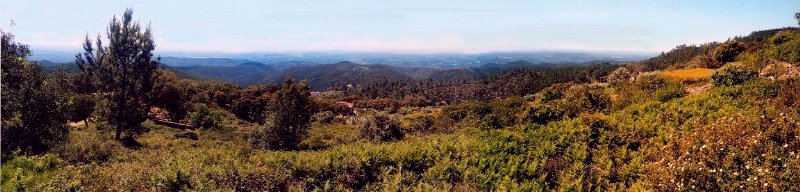
Monchique The drive through the Monchique hills is a particularly beautiful and one can stop for walks through the lovely woods, full of wild flowers. On clear days you can admire breathtaking views stretching twenty miles to the sea. Visit the Spa village of Caldas de Monchique which is very picturesque; stop at one of the many restaurants for lunch and enjoy the local specialities such as Chicken Piri-Piri; then go on to Foia, the highest point on the Alagrve. There are many local craft shops in the Monchique region. |
| Colinas Verdes Literally "green hills", 9 Km
inland from Lagos, situated in beautiful rolling
countryside that is very reminiscent of Dorset. The
views are quite spectacular. Nearest shopping is in
Portelas with Lagos a few km further on. |
| Sargaçal A small village 4,5 km inland from Lagos.
Nearest convenient shopping is in the village of
Portelas or alternatively one can walk over the
fields into the village itself. On rising ground with
superb rural views and down to the sea at Lagos. |
| Falfeira On elevated land within walking distance of the
town centre, great views of Lagos, countryside and
the sea. |
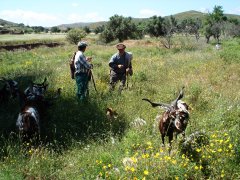 Canafechal A hamlet in the Ribeira de Arão, where oleanders grow wild along the river banks and herds of goat nibble on flowering herbs. Great walking and riding.
Barão S. João A small inland village that has been relatively untouched by tourism - one of many like that in the Western Algarve, which is much more 'untouched' and traditional than the area around Faro. The village is a pretty ride along country roads, 11Km from Lagos. You may continue through the village to the village of Espiche, to Luz or to Sagres and the West Coast. |
|
Shopping, Eating and Entertainment You will find numerous supermarkets, butchers, bakers, etc in Lagos. The municipal food market on the main avenue is open every weekday morning until 1pm and offers a variety of fish and meat on the groundfloor, fruit and vegetable upstairs. There is also an open-air market normally held on Saturdays, near the main Avenue. Exploring the old part of town, searching out new restaurants is marvelous, most have tables outdoors in season, set beneath fragant orange trees in the square or lined along The edges of the narrow streets. There is a fantastic selection with many specialising in fresh fish which is delicious. You will also find a good choice of International fare on offer with Indian, Chinese, Italian, French, English, French, Dutch and Indonesian restaurants in around town. Lagos has an excellent nightlife, centered around the old town. Merely wandering through the maze of winding streets soaking up the atmosphere is entertainment enough but you will come across a good choice of bars and discos to suit a variety of tastes. Alternatively sample a traditional Portuguese night out, dine, dance and be entertained by traditional Fado singing, you can find also the cinema and in Centro Cultural, there are sometimes expositions, classics music concerts and some shows. Local favorite: We highly recommend the local O Caseiro restaurant, at a few minutes from the quinta. The kitchen is basic but everything is done with love and using good local ingredients. To get there go left at the bottom of the driveway, take the first asphalted right, then the first left, a narrow little lane, then the first right and you will find the restaurant on your left in a hundred meters. The atmosphere is relaxed and unpretentious. Few tourists go there, but the place is popular with foreign residents of the immediate area. |
 |